Metric Rational:
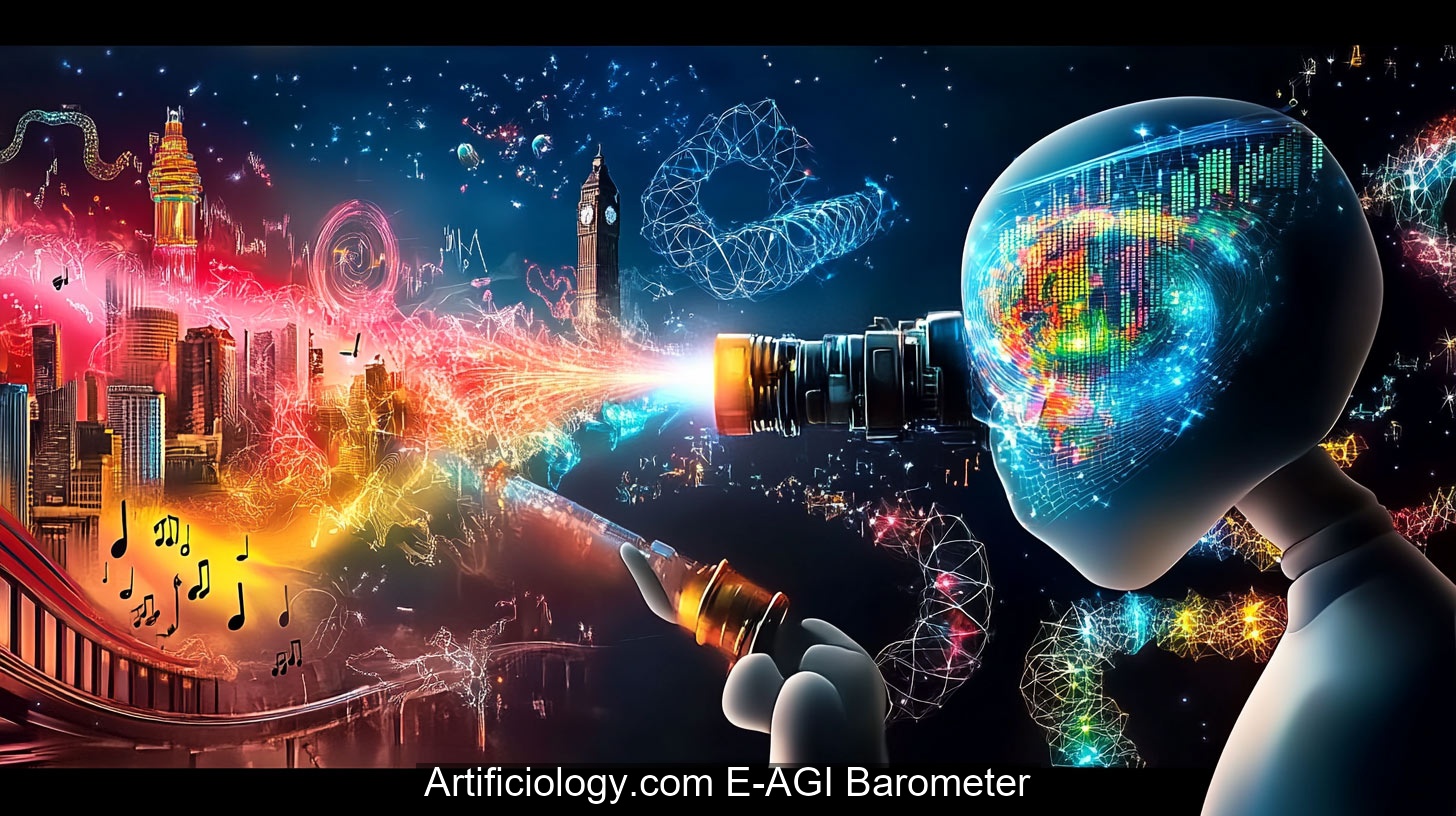
Cross‐Domain Inspiration involves drawing on ideas, methods, or patterns from one field of knowledge to spark innovations in a totally different domain. Humans often engage in this process unconsciously—like an engineer who adapts nature’s designs (biomimicry) to optimize mechanical structures, or a musician who borrows mathematical symmetry to compose experimental pieces. By stepping outside conventional boundaries, cross‐domain inspiration can push creativity to new heights, breaking routine models and generating unique outcomes that pure in-domain thinking might never produce.
For an AI or humanoid robot, cross‐domain inspiration signifies a deliberate attempt to bridge separated areas of expertise. The system might, for instance, apply network optimization techniques from computer science to reorganize a retail store layout more efficiently, or transfer narrative structures learned from classic mythology into designing user onboarding flows in software. Achieving this requires both broad knowledge coverage—an ability to represent concepts from different fields—and flexible reasoning that can spot connections or parallels. For instance, an AI might note that a challenge in civic planning (traffic congestion) shares structural resemblances with queue management in data networks, inspiring novel traffic‐light algorithms.
A key challenge is identifying which aspects truly map across domains. An AI that tries to transplant a concept blindly may produce nonsense if the analogy is superficial or if the constraints differ drastically. Thus, cross‐domain inspiration requires deeper functional or structural matching: noticing that a certain biological growth pattern and a manufacturing production line share a principle of distributed resource allocation. Another challenge is avoiding domain collisions—mixing ideas that yield impractical or irrelevant solutions. The AI must filter out misguided analogies or test them carefully, verifying that the cross‐pollination indeed contributes something beneficial.
In practice, the system might store discrete knowledge modules in each domain—like “architecture,” “linguistics,” “combinatorial optimization”—and use triggers or prompts to find potential synergy. Sometimes, user queries serve as catalysts: “We want a new approach to classroom design. Are there concepts from horticulture that might help us?” The AI then scans horticultural strategies (such as layering vegetation for ecosystem balance) and proposes layered classroom designs that promote diverse learning zones. Or the AI itself might spontaneously sense conceptual resonance—spotting a pattern in code version control that maps to genealogical branching in biology, leading to novel software repository management strategies.
When evaluating cross‐domain inspiration, observers watch how many fresh, valuable ideas emerge that legitimately fuse elements from distinct fields. Researchers track uniqueness, relevance, and feasibility. They also consider user satisfaction: does the cross‐inspired concept truly address the target domain’s needs? Another measure is the system’s adaptability—does it shift between different source domains fluidly, or fixate on shallow analogies that confuse more than help?
Ultimately, cross‐domain inspiration expands an AI’s creative power, letting it rummage across conceptual territories. By spotting parallels, bridging methods, or recombining theories, the system transcends narrow problem‐solving. This fosters breakthroughs—like melding architectural aesthetics with biological efficiency or merging musical composition heuristics with data encryption approaches. Through systematic cross‐domain hunts for synergy, the AI can demonstrate intellectual leaps reminiscent of human “eureka” moments, spurring innovation that might reshape design, art, science, and beyond.
 >
>