Metric Rational:
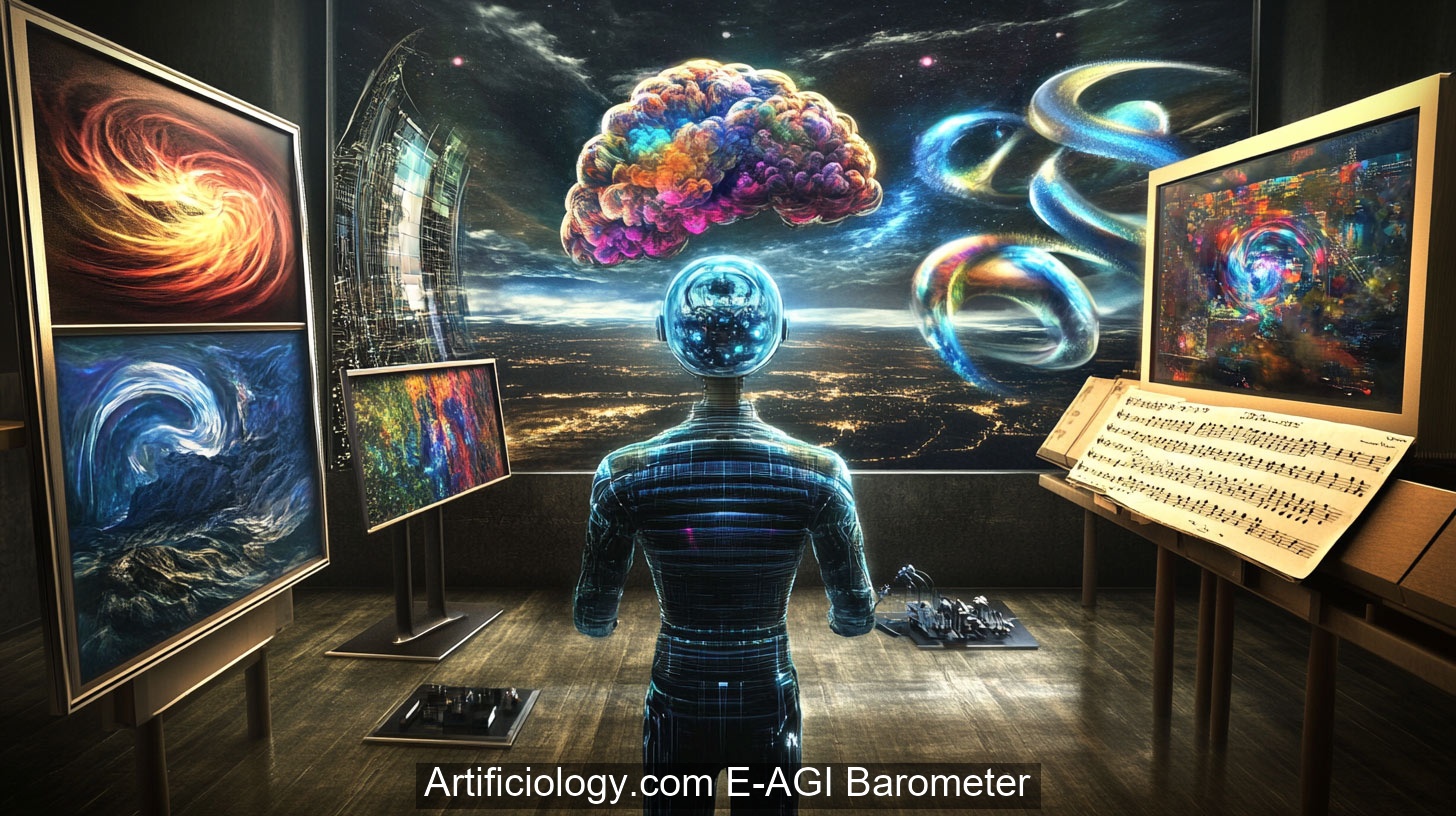
Multi‐Medium Mastery refers to an AI or humanoid robot’s ability to excel across diverse creative or expressive mediums—such as text, images, music, 3D design, or mixed reality—while maintaining a consistently high level of quality. In human creativity, mastering multiple media might include an artist adept at both painting and sculpture, or a filmmaker equally skilled at scriptwriting, directing, and sound design. For an AI, multi‐medium mastery implies the capacity to generate or refine outputs in varied forms without defaulting to a single domain or showing drastic drop-offs in skill from one medium to another.
At its core, multi‐medium mastery involves breadth and depth. Breadth means the system can handle multiple forms of media—like writing short stories, composing music, painting digital art—while depth ensures it meets professional or near-professional standards in each. This demands specialized knowledge for each medium (e.g., color theory in illustration, chord progressions in music, narrative arcs in text), plus a unifying sense of design or expression that can be adapted across different formats.
Challenges include:
Technical Variation: Each medium has unique technical demands—2D digital art might focus on layers and brushes, while 3D modeling concerns geometry and rendering. Music composition includes harmony, melody, tempo, while writing text requires grammar, style, and plot structure. The AI must master distinct toolsets or data representations.
Aesthetic Consistency vs. Adaptation: If a user wants a cross-media project (e.g., a game with coherent music, artwork, and storyline), the AI has to unify the “style” or theme across each medium, while respecting the medium-specific constraints.
Learning Curves: Training or rule-based strategies for each domain can be resource-intensive. Ensuring equal competence often involves bridging domain knowledge (e.g., a color palette that also influences the mood of background music) or advanced transfer learning.
User Appropriateness: People might have different expectations for each medium. A game’s visuals might be stylized, whereas its soundtrack requires emotional resonance. The AI balances user goals and domain best practices for each medium.
To evaluate multi‐medium mastery, testers might request an integrated creative package—like a short promotional video with original music, text captions, and a consistent brand aesthetic. They see if each component meets domain-specific quality benchmarks, rather than showing a strong main part (e.g., good text) but weak accompanying visuals or audio. Another approach is parallel tasks across media: the AI composes a poem, paints an illustration on the same theme, and produces a short musical piece. Consistency (how each piece complements the central concept) and individual quality (whether each stands on its own merit) are assessed.
Achieving multi‐medium mastery can dramatically expand an AI’s role in content creation pipelines, from marketing campaigns to game development. By seamlessly blending textual storytelling, visually compelling designs, and emotionally charged music, the AI provides holistic creative solutions. Over time, advanced systems might even unify mediums adaptively—synchronizing background music with color shifts, or pairing narrative tension with art transitions—thus pushing the boundaries of integrated multimedia production.
 >
>