Metric Rational:
Energy transfer and conversion describes an agent’s understanding and manipulation of processes whereby energy changes form or location, from mechanical to electrical, chemical to thermal, or kinetic to potential. In human cognition, people typically develop an intuitive sense of these transformations early on—feeling the warmth when hands are rubbed together, recognizing that food supplies bodily energy, or noticing that a battery powers devices through stored chemical potential. Such understanding underpins more advanced reasoning about thermodynamics, power systems, and resource management (e.g., fueling a car, heating a building).
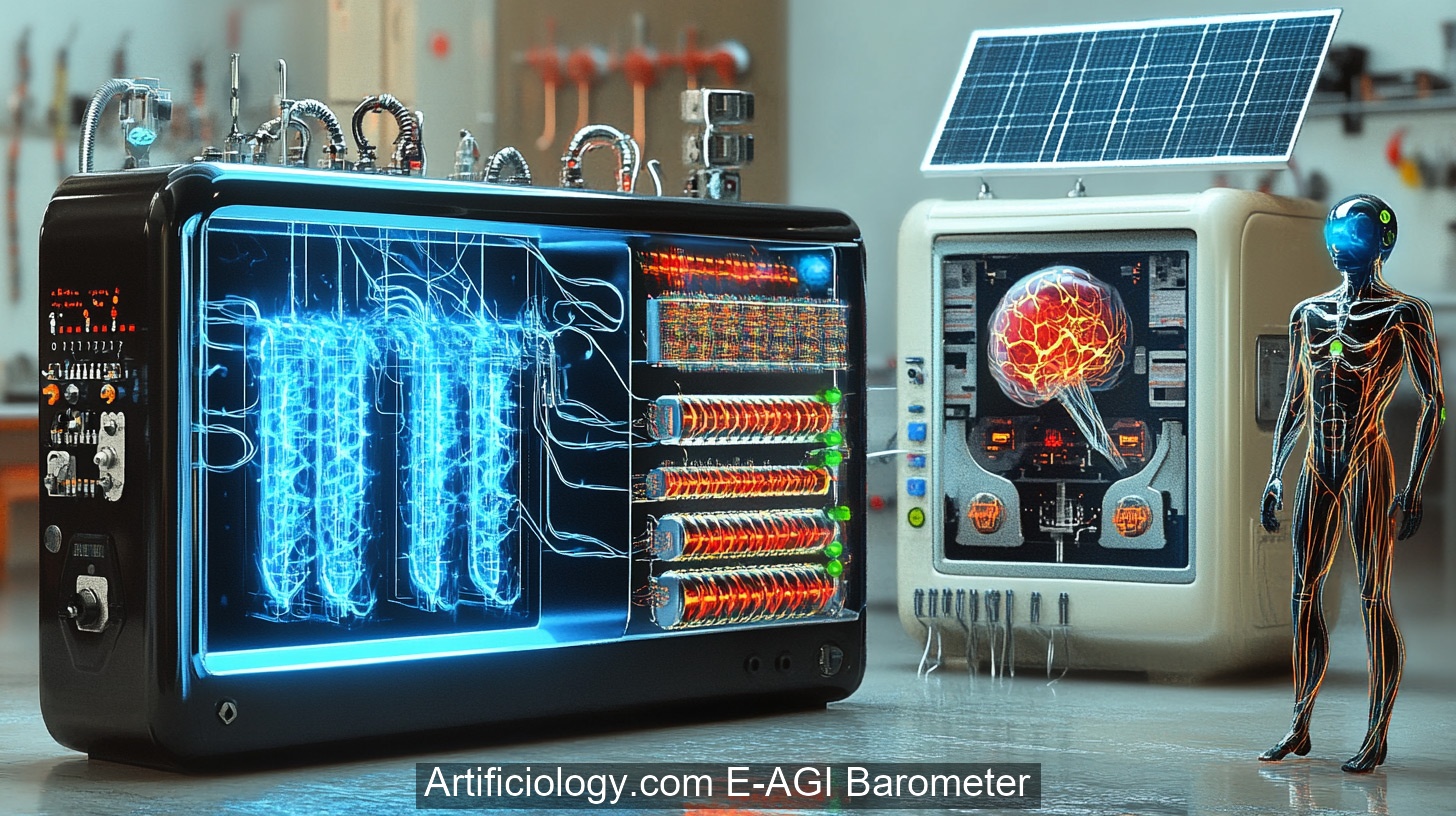
For embodied AI or robotic systems, this skillset entails both conceptual understanding of energy flows and practical execution of energy-efficient actions. On the conceptual side, the system might predict that a heavier load requires more battery power for movement or that frictional heat should be minimized in mechanical joints. Practically, it manifests when a robot regenerates energy while braking or recycles waste heat, signaling an ability to manage internal resources intelligently. Converting energy from one mode to another—say, using solar panels to charge batteries, then running actuators from that stored energy—demands dynamic monitoring of input/output levels, temperatures, or voltage thresholds.
An AI or robot with strong mastery over energy transfer and conversion also anticipates the potential side effects—like losses due to inefficiencies (resistance in wires, heat leakage from motors). It may dynamically shift operational modes based on supply constraints or environmental conditions. For example, a mobile robot might slow down if battery levels drop or reroute some tasks to conserve power until it reaches a charging station. Similarly, an industrial manipulator with advanced intelligence could route certain mechanical tasks through a stored-energy system that reclaims gravitational potential (like leveraging counterweights or springs) for repeated lifting motions.
Another core aspect is synergy with other metrics: understanding energy flows intersects with force dynamics (Metric 37), as force and energy are intimately linked. Wave/signal interpretation (Metric 38) can reveal how the agent captures or absorbs energy from signals. Even emotional intelligence aspects might come into play if the system needs to communicate clearly why it must conserve power in a given scenario, or negotiate resource usage. Hence, robust energy-awareness enables more holistic, adaptive reasoning.
Evaluating a system’s capacity for energy transfer and conversion focuses on both theory and practice. Theoretical tasks might test if the AI can calculate energy budgets or design a process that leverages thermal differences. Practical tasks test real-time decisions about power usage or the creative harnessing of environmental energy sources. Assessors look at efficiency (how little energy is wasted), safety (avoiding overloads or overheating), and adaptability (shifting approaches if a power source is interrupted). High-level performance suggests the AI/robot can navigate complex energy networks, ensuring stable operation under changing conditions while maximizing overall productivity.
Ultimately, skillful handling of energy transfer and conversion is a hallmark of advanced intelligence, underscoring an agent’s capacity to manage resources, adapt to environmental constraints, and collaborate with human operators in real-world tasks. By demonstrating thorough awareness of how energy manifests, moves, and morphs, an embodied AI takes a major step toward true autonomy and sustainable performance.
 >
>