Metric Rational:
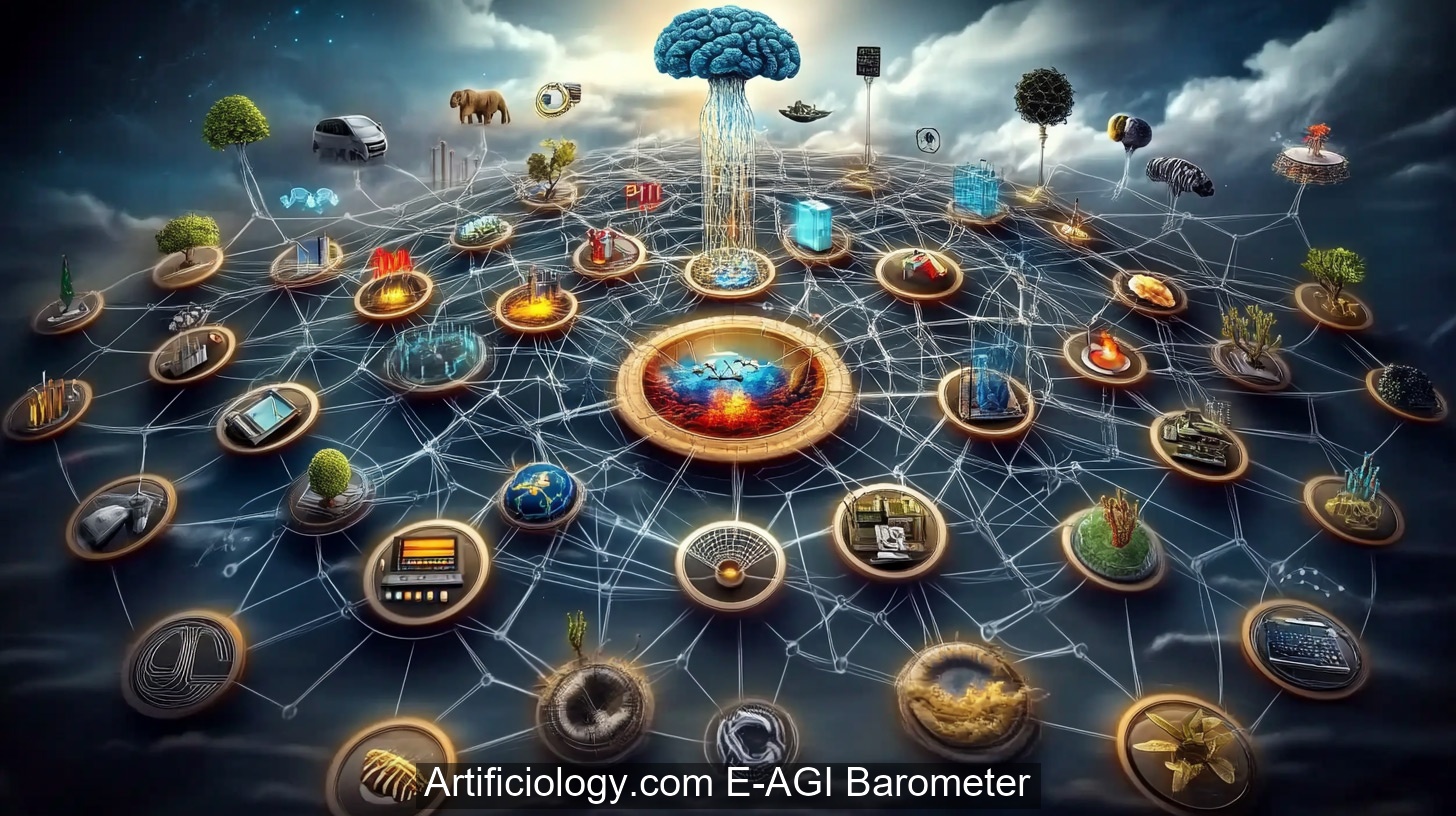
Entity and relationship mapping refers to an agent’s capacity to identify distinct elements within a complex system—people, objects, concepts, organizations, locations—and understand how these elements connect. In human cognition, this capability surfaces when we grasp social structures (e.g., who is related to whom), the hierarchy in a workplace, or the functional interplay among components of an ecosystem. Recognizing entities is only the first step; robust comprehension comes from appreciating how each one interacts, influences, or depends on others.
For an embodied AI or humanoid robot, entity and relationship mapping spans various domains. On a social level, the system might discern that Person A is the supervisor of Person B, who in turn coordinates with Person C. On a functional or ecological level, it might discover that water availability affects local plant growth, influencing the feeding patterns of nearby animals, which ultimately shapes the health of an entire habitat. In short, building accurate maps of entities and their interrelationships enables more grounded decision-making and nuanced predictions.
Achieving this metric hinges on perceptual and cognitive layers. Perceptually, the AI must reliably detect distinct agents or objects (via sensors such as cameras, microphones, or textual data inputs). Cognitively, it must integrate multiple streams of evidence—linguistic cues, observed behaviors, contextual signals—to group entities and infer relationships. For instance, a household robot may note repeated instructions from one individual, labeling that person as “primary homeowner,” or detect that two people share a living space, inferring they might be family members. In a supply chain scenario, the AI might identify each logistical node—warehouses, transport vehicles, shipping ports—and map how goods flow between them.
Evaluating an AI’s entity and relationship mapping involves observing how well it navigates new, unstructured situations. Can it build a graph of relationships from scratch if provided with raw sensor or text data? Does it update these graphs dynamically as relationships shift—for example, if a new team member joins a project or if a predator changes hunting grounds? Importantly, does the AI use these maps effectively to guide behavior, such as choosing the correct person to ask for instructions, or predicting conflict points in a social group?
Scalability and abstraction levels also matter. A small set of entities might be easy to track, but real-world scenarios often involve numerous overlapping relationships across multiple contexts. The system’s ability to condense complex data—identifying the “essence” of who or what matters and how they connect—separates advanced entity/relationship mappers from those that merely store details in an unstructured manner. Temporal dynamics add another layer: relationships and roles can evolve over time, requiring continuous updates to the internal representation.
Overall, entity and relationship mapping forms a backbone for higher cognitive tasks like scenario analysis, conflict resolution, resource planning, and social interaction. By modeling how components within a system interlink, an embodied AI can adapt more swiftly to changing conditions, reason about indirect effects, and engage in collaborative or socially conscious behaviors.
 >
>