Metric Rational:
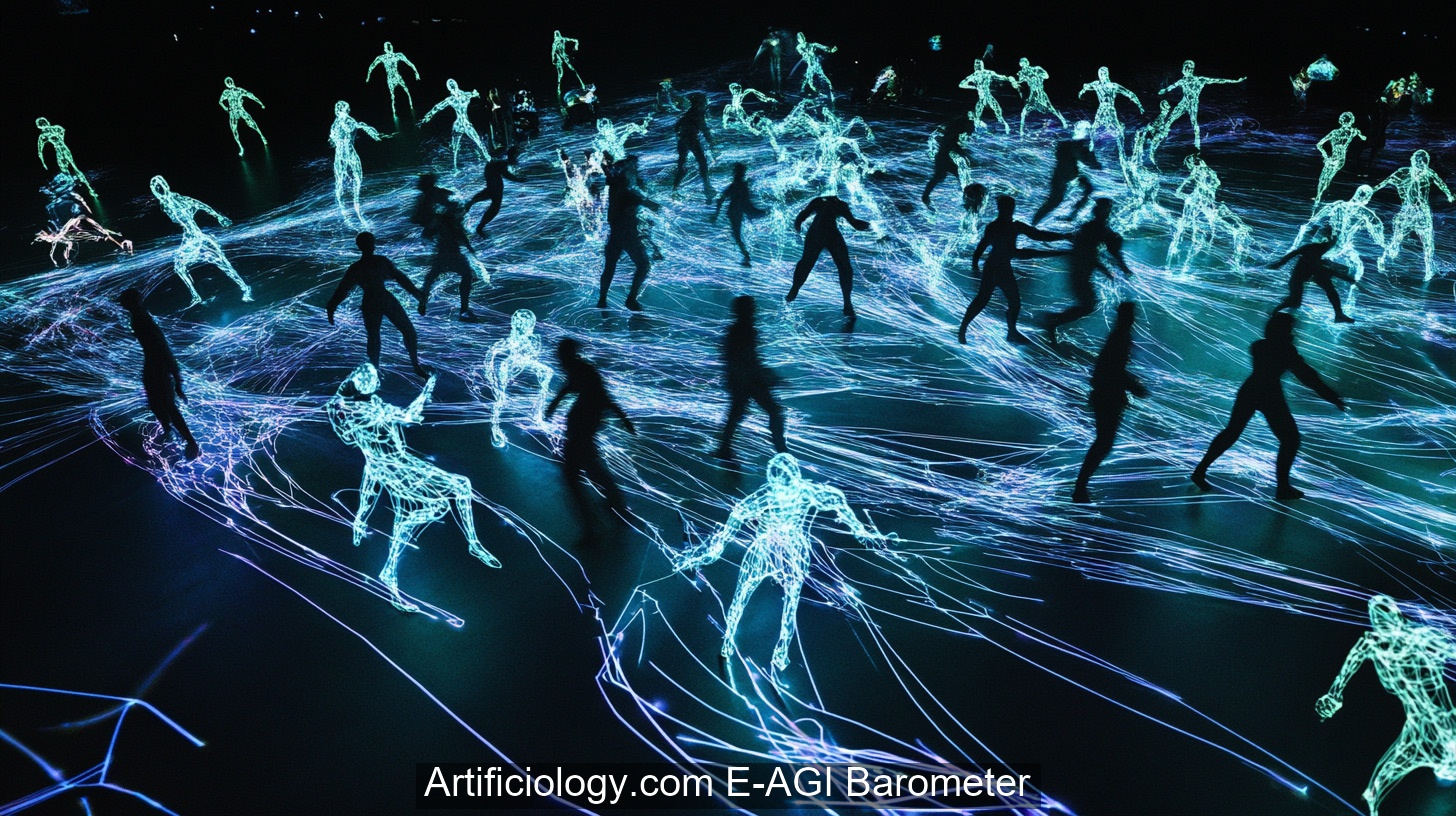
Collective behavior prediction focuses on forecasting how groups of agents—be they animals, humans, robots, or a mix—will act when functioning as a larger unit. In biological contexts, flocking birds and schooling fish create patterns that look choreographed but emerge organically from local interaction rules (like alignment with neighbors, collision avoidance, and attraction to the group). Humans also exhibit collective behaviors in scenarios such as crowd movement, protest assembly, market trends, social media virality, or traffic flow. Despite individuals each following personal motives, group-level outcomes can be surprisingly organized or can escalate rapidly due to feedback loops.
For an embodied AI aiming to function within or manage group settings, collective behavior prediction is key. A service robot in a bustling train station should anticipate crowd surges around arrival times, adjusting paths and wait times to avoid collisions. An autonomous drone working with others in a swarm must model how its neighbors respond to obstacles so the entire formation remains coherent. On a social or organizational level, an AI that helps plan public events would benefit from forecasting how crowd distribution shifts over time, identifying potential bottlenecks or safety risks.
Computationally, predicting collective behavior often requires blending agent-based modeling (where each entity follows a set of local rules) with statistical or machine learning approaches that look for emergent patterns. The AI might pick up signals of coordination or alignment early on—for example, noticing how a few influential social media users can spawn large-scale trends. Another layer involves detecting pivotal thresholds, sometimes known as tipping points, at which small changes in conditions can unleash dramatic collective shifts (like sudden panic or a flash mob forming).
Critical to this metric is an AI’s agility: it must adapt quickly if group patterns deviate from historical norms. If a protest crowd spontaneously changes route, a predictive system should revise its estimates in near-real time, updating potential outcomes for crowd safety. Robustness also matters; real collective dynamics can be chaotic, with partial or noisy data, so the AI’s model needs to cope with incomplete information or novel circumstances. Additionally, the system’s ability to provide interpretable predictions is valuable—practical usage requires explaining not just what might happen, but why, and how likely it is under various conditions.
Evaluation of collective behavior prediction spans multiple test arenas: from simulating multi-lane traffic flow to mapping how rumors spread in social networks. Researchers measure how accurately the system’s forecasts match actual outcomes, how soon it detects emerging patterns, and how gracefully it updates its estimates when group dynamics shift unexpectedly. A more advanced approach may even propose interventions to steer group behavior—suggesting route diversions to alleviate congestion, or communication strategies to prevent mass panic.
Ultimately, strong performance in collective behavior prediction enables an AI or robot to co-exist and collaborate effectively in complex, multi-agent environments. By discerning group-level trends from individual actions, it fosters better decision-making, preemptive risk mitigation, and more harmonious interactions within large-scale systems.
 >
>