Metric Rational:
Vocal tonality analysis is the capacity to interpret and classify the affective or emotional states, as well as other subtle cues, that are embedded in the pitch, rhythm, loudness, and timbre of a speaker’s voice. In human conversations, we naturally pick up on these tonal variations—recognizing when someone is excited (more pitch variability and higher volume), sad (lower pitch, softer volume), or stressed (faster speech rate, tense intonation). These acoustic signals often convey critical context, sometimes contradicting the literal meaning of words. For instance, the phrase “I’m fine” can indicate genuine well-being or frustrated sarcasm, depending on vocal tonality.
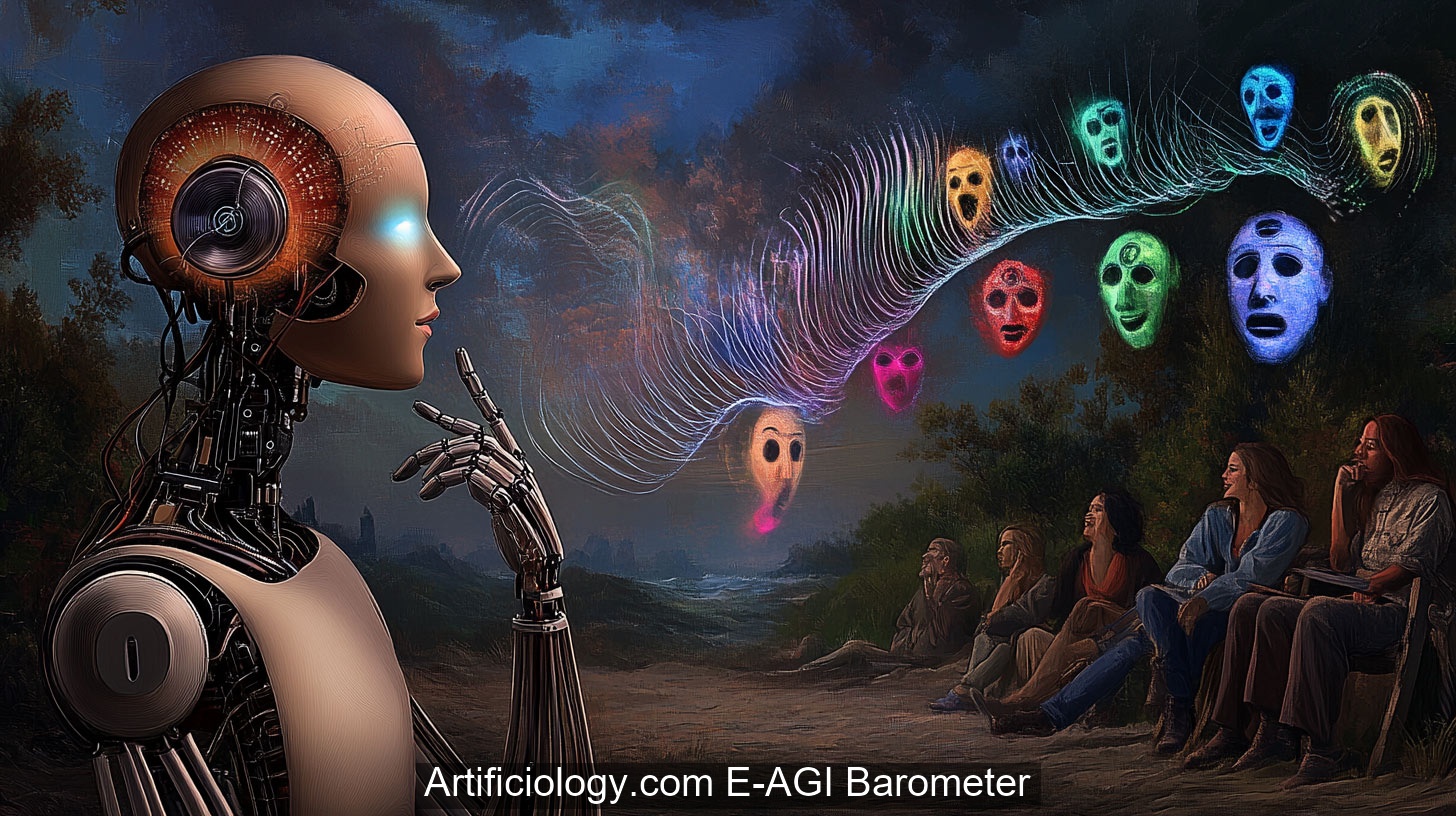
For an AI or humanoid robot, vocal tonality analysis involves processing audio input from a speaker to decode emotional or situational signals that words alone might not convey. Systems use feature extraction—detecting pitch contours, amplitude fluctuations, and spectral details—alongside machine learning models that correlate specific acoustic patterns with emotional states (e.g., joy, anger, fear, sadness). Beyond raw emotion detection, advanced approaches can infer deeper cues like tension, confidence, or boredom. The result is a more nuanced interpretation of user intent and engagement. A teacher-assisting robot, for example, could detect a child’s mounting stress by subtle vocal changes, prompting timely intervention or encouragement.
One challenge is contextual variation: pitch and volume differ naturally by individual, culture, and language. A person with a naturally high pitch might be misclassified as excited if the system relies on average pitch alone. Similarly, cultural norms shape how people express emotions vocally—some might speak softly even when upset, while others raise volume for emphasis. Handling such diversity means calibrating models to factor in speaker baselines and cultural differences. Another layer is acoustic noise: real environments often have competing sounds that interfere with voice signal clarity. The AI must clean or filter audio to isolate relevant vocal features accurately.
Accurate tonality analysis also integrates time-series context. A sudden drop in volume or a slow crest in pitch might matter only within the context of preceding utterances. Systems track patterns over multiple seconds or turns, rather than focusing on a single snapshot. Emotional states can also evolve mid-sentence, demanding continuous monitoring rather than a one-off classification.
Evaluating success in vocal tonality analysis typically involves benchmark datasets with labeled emotional segments, enabling comparison of accuracy in identifying each tone or emotion. Researchers also measure how robustly the system handles diverse speaker sets—age, gender, accent—ensuring minimal bias or performance degradation. Another facet is real-time adaptability: can the AI detect shifts quickly enough to adapt its responses mid-conversation, perhaps switching to a more comforting tone if it senses user distress?
Ultimately, proficient vocal tonality analysis empowers more empathetic and intuitive human-AI communication. The AI can respond sympathetically when a user’s voice trembles with nervousness, or celebrate with an uplifting response to a user’s excited exclamation. This fosters deeper rapport, enabling the system not only to parse language content but also to align with the user’s emotional state—bridging the gap from functional service to socially intelligent interaction.
 >
>